
By Ben, EZ Haulaway · Published · Updated
Air Conditioner Disposal: Legal, Free and Paid Ways to Do It
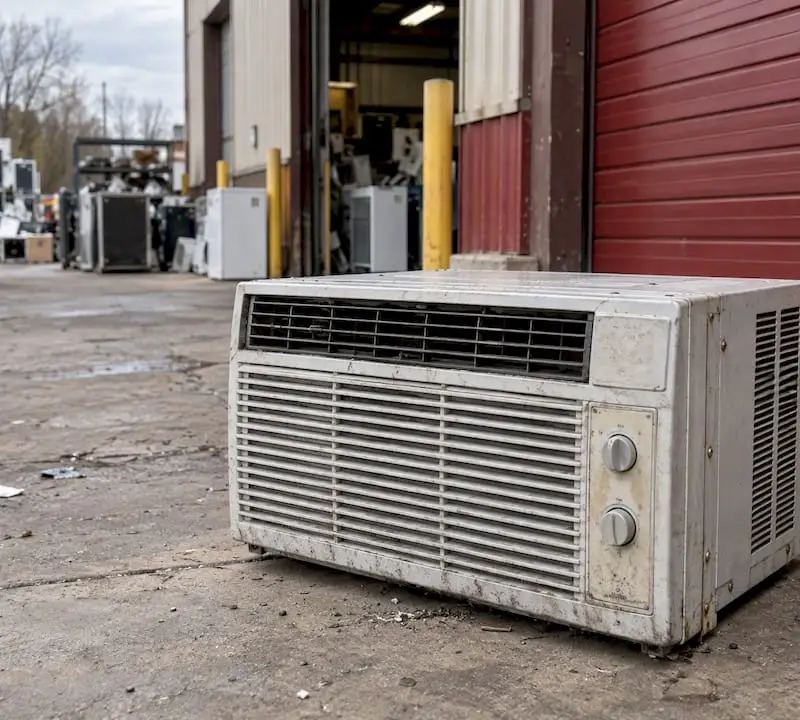
You can’t put an old air conditioner in the trash or leave it at a landfill gate as if it were a broken chair. The refrigerant inside has to be recovered first, so your real choices are a city or utility pickup, a retailer or installer haul-away, a scrap or recycling drop-off, or a junk removal crew that takes it to the right facility. This guide covers each route, what the federal rules say, what is available in the Denver metro area, and how to pick the one that costs you the least time.
TL;DR
- Window, portable and central AC units contain refrigerant that must be recovered before the metal is recycled, so they don’t belong in household trash.
- Free routes exist: your electric utility, your city’s bulky-appliance service, a retailer or installer doing a replacement, or a scrap recycler.
- Most free routes come with conditions: an appointment, a working unit, a curb or garage location, or a qualifying fridge pickup.
- In the Denver area, we haul AC units away with the cleanup done. Send a photo and you get a quote before anyone shows up.
- A broken, heavy or awkward unit is usually where paying for removal makes sense.
Table of Contents
- Why an air conditioner can’t go in the trash
- Your options, side by side
- Free and low-cost routes to try first
- Preparing a unit for pickup
- When paying for removal makes sense
- How we handle AC removal in the Denver area
- Our perspective on AC disposal
- Common mistakes to avoid
- FAQ
- Sources
Why an air conditioner can’t go in the trash
An air conditioner is a sealed system holding refrigerant and oil. ENERGY STAR explains that room air conditioners contain refrigerants, oils and other compounds that federal law requires to be removed and recovered before the steel, other metals and selected parts are recycled.
The rule falls on whoever ends the chain. The EPA states that the final person in the disposal chain, a landfill owner included, must make sure the refrigerant is recovered before final disposal. It also singles out window air conditioners, which commonly enter the waste stream with their refrigerant charge intact, as subject to special safe-disposal requirements.
In practice, that is why a transfer station may turn away a unit that still has its charge, and why a trash hauler will leave it at the curb with a sticker on it. Do not cut lines, puncture the coil or “drain” the unit yourself. Refrigerant recovery is work for a certified technician or a recycler set up for it. The EPA says its Section 608 certification generally covers people doing service, repair or disposal work that could reasonably be expected to release refrigerant, with exceptions for small appliances and certain motor-vehicle equipment.
What happens to the unit afterward
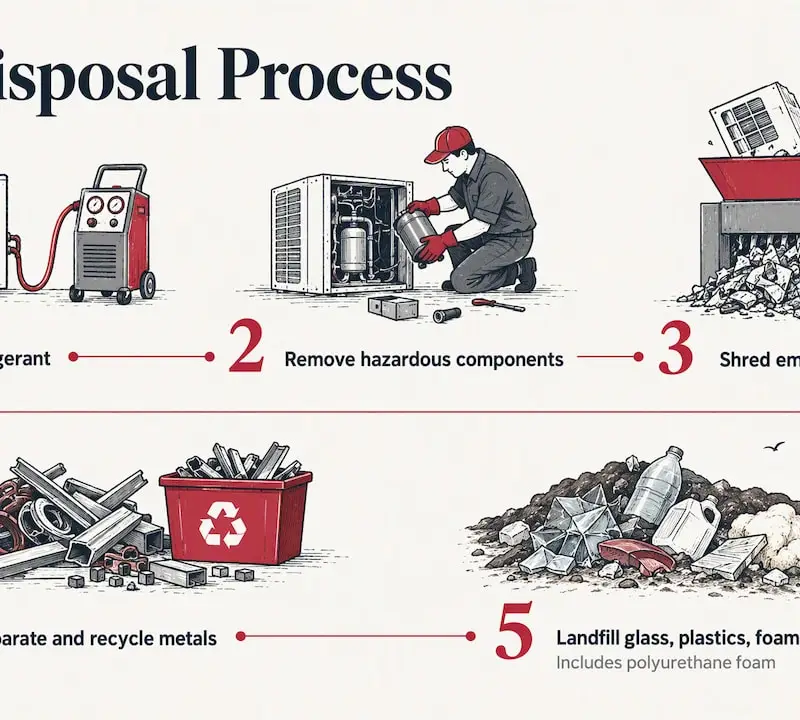
When a unit is collected properly, the EPA describes a process of refrigerant recovery, removal of hazardous components, and shredding of the emptied appliance. Metal parts are typically separated and recycled. Glass, plastics and polyurethane foam usually go to a landfill. That is useful to know: recycling an AC is mostly about recovering the gas and the metal, not about keeping the whole machine out of the waste stream.
Your options, side by side
There is no single best answer. It depends on whether the unit works, how big it is, who is replacing it and how much your time is worth.
| Option | Typical cost to you | Best for | Watch out for |
|---|---|---|---|
| Utility turn-in or pickup program | Free, sometimes a rebate | Working room units, especially with a qualifying fridge | Working-condition, age and size rules |
| City bulky-appliance collection | Free in some cities | Residents served by city trash service | Appointment required, curb or alley placement |
| Retailer or installer haul-away | Often bundled with a new unit | Replacements | Confirm it is in the quote |
| Scrap or recycling drop-off | Free, sometimes paid for the metal | Central units, compressors, bulk metal | Acceptance rules, refrigerant recovery first |
| Junk removal crew | Priced by item or load | Heavy, broken, multiple items, tight timelines | Get the quote in writing before the visit |
Free and low-cost routes to try first
Your electric utility
The EPA’s advice is to check your electric utility first for a rebate or bounty program, and to confirm requirements such as working condition, minimum age or minimum dimensions. ENERGY STAR notes that some utilities and partners offer incentives or run turn-in events for room air conditioners, and its database lets you search by ZIP code for local programs.
A 2025 ENERGY STAR guide to turn-in programs reports that more than one-third of U.S. states and territories included room air conditioners in State Energy Efficient Appliance Rebate Programs. It adds that many rebate programs require you to recycle the unit you replace, or pay a higher rebate when you do.
Xcel Energy customers in Colorado
If you are an Xcel Energy electric customer, the Xcel refrigerator recycling program offers a $50 rebate for an old working fridge or freezer. It will also pick up a window or room AC unit alongside a qualifying fridge or freezer. The program states that no additional rebate is paid for the AC unit itself. So this is a free disposal route for a room unit, but not a money-maker, and only if you have a qualifying fridge to send with it.
As one Colorado city’s page describes it, a qualifying fridge must be in working order, measure between 10 and 30 cubic feet and be plugged in at pickup. Program terms change, so confirm the current rules on Xcel’s page before you schedule.
Your city or county
Municipal rules vary a lot. The EPA suggests asking your municipality about appointments, drop-off at a transfer station or landfill, and whether refrigerant must be recovered before pickup. In the Denver area, the City and County of Denver lists air conditioners among the appliances its Solid Waste Management service collects for free by appointment, for residents it serves. The page directs you to call (720) 913-1311 to book. If you live in Aurora, Lakewood, Littleton, Centennial, Castle Rock, Parker or an unincorporated part of Douglas County, check with your own city or trash hauler, because the Denver program is for Denver’s residents.
Other cities run similar programs with tighter conditions. New York City, for example, requires an appointment for CFC-appliance disposal including air conditioners, and only collects tagged appliances. It also warns that newer units using R600a or R32 are not accepted through that service. The lesson applies everywhere: the refrigerant type and the tag matter, so read your unit’s nameplate before you call.
The retailer or the installer
If you are replacing the unit, ask the seller first. ENERGY STAR says an installing contractor is often responsible for hauling away and properly disposing of or recycling used central HVAC equipment, and otherwise points you to local recycling or solid-waste providers. HVAC.com’s June 2025 guidance recommends confirming that a central-AC installer’s quote includes old-unit removal, refrigerant recovery and hauling. Get that line item in writing before you sign. Some retailers also offer pickup when they deliver a new window unit.
Selling it for scrap
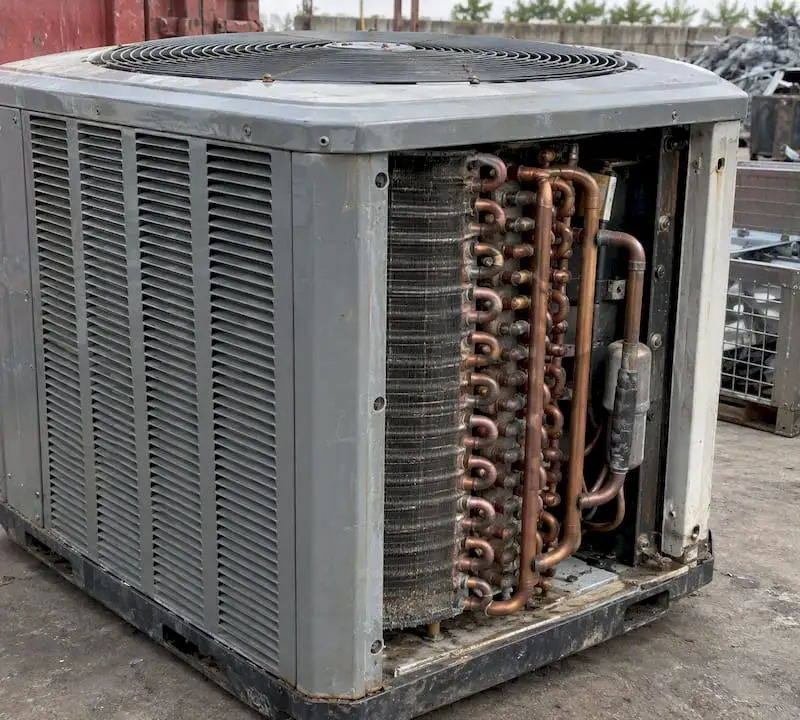
Can you make money? Sometimes, a little. HVAC.com notes that copper and aluminum may carry scrap value after proper refrigerant recovery, and it advises calling a scrap-metal recycler before you deliver, because acceptance requirements vary. Expect many yards to refuse a unit that still holds its charge. A small window unit is usually worth less than the gas and time it takes to drive it across town. A large central condenser with a copper coil is a better candidate.
Preparing a unit for pickup
A few minutes of prep keeps a pickup from falling through.
- Read the label. Note the make, model, refrigerant type and whether it is a window, portable, split or central unit. Photograph the nameplate.
- Check the program rules. Utilities and cities may set working-condition, age or size limits, and may require a bulky-item appointment or drop-off.
- Leave the refrigerant alone. Do not open the sealed system.
- Unplug and drain. Let the unit sit, empty any condensate from portable models and remove the window bracket, side curtains and loose foam.
- Clear the path. Move it to a garage, driveway or curb if the pickup is outdoor-only. Window units are awkward and often heavier than they look, so use a second person on stairs.
- Gather the extras. Dehumidifiers, old fans and a stray mini-fridge often travel together.
When paying for removal makes sense
Free programs are worth trying when you have time and a working, qualifying unit. They stop working when:
- the unit is broken or too old to qualify;
- it is a heavy portable, a rooftop or a ground-level condenser you cannot lift;
- you are clearing a whole garage, basement or rental unit and the AC is one item among many;
- you have a closing date, a move-out or a tenant turnover;
- the city’s appointment is weeks away.
That is where a junk removal crew earns its fee: one visit, the lifting done, and the unit delivered to a facility that handles refrigerant correctly.
How we handle AC removal in the Denver area
We are a family-owned crew based in Parker, Colorado, and we serve Denver and the surrounding metro area, including Douglas County. Air conditioners come out as part of our appliance removal service, and the full list of what we haul is on our what we take page. Labor, loading, haul-away and cleanup are part of the price.
Here is how pricing is published on our pricing page. Appliances with refrigerant carry a Freon appliance handling fee of $100 per unit. A minimum or small load is $120 and a 1/8 trailer is $120. Washers and dryers are $100 per unit and refrigerators are $150, to give you a sense of how single appliances are priced. If your AC is going out with other things, a fraction-of-a-trailer price usually covers the lot: a 1/4 trailer is $240 a 1/2 trailer is $420 and a full trailer is $840. Extra labor is $50 per hour per crew member when a job needs more hands.
The simplest way to get an exact number is to send a photo through our instant quote page. We confirm what the job costs before we arrive, so there are no surprise fees on the day.
If you are in the middle of a bigger project, we also do house and estate cleanouts, and for offices and properties with several units to clear there is commercial junk removal.
Our perspective on AC disposal
Most calls we get about air conditioners start the same way: the person tried the free route, hit a rule they didn’t know about, and now has a unit sitting in the garage. The utility wanted a working fridge. The city needed an appointment three weeks out. The scrap yard asked whether the refrigerant had been recovered.
Our advice is plain. If the unit works and a free program fits, use it. It is a good result for you and for the environment. If you are replacing a central system, make the installer put removal in the quote. If neither applies, or the unit is one of many things you need gone, a flat, photo-based quote saves you more than it costs, because you stop spending Saturdays on phone calls and truck rentals.
We keep our process simple on purpose. A local crew, not a call center, looks at your photo, tells you the price and shows up when we said. We treat your property with care and sweep up when we leave. Where items can be donated or recycled, we send them that way instead of to a landfill.
— Ben
Common mistakes to avoid
- Leaving the unit at the curb on trash day. Many haulers will not take it, and it can be tagged or left behind.
- Dropping it at a landfill without calling. Facilities have refrigerant rules and may refuse a charged unit.
- Assuming the free program covers everything. Check working-condition, age and size terms first.
- Forgetting the installer. Removal is often already part of a replacement job, so ask before you pay twice.
- Disconnecting lines yourself. It risks releasing refrigerant, and it can make a recyclable unit harder to place.
FAQ
How do I get rid of an old window AC unit?
Start with your electric utility, city or the retailer selling you the replacement. If none of those fit, a scrap recycler or a junk removal service can take it. Whoever takes it must make sure the refrigerant is recovered before final disposal.
Can I throw an air conditioner in the dumpster?
No. EPA rules put the burden on the final person in the disposal chain to ensure refrigerant recovery, so haulers and landfills often refuse charged units. Using a dumpster can also bring fines or a refused load. Use a program or service that handles refrigerant.
Can I get paid for scrapping an AC unit?
Sometimes, but not much. Copper and aluminum can have scrap value once the refrigerant has been recovered, and some utility programs pay rebates, though Xcel’s states that its AC pickup carries no added rebate. Call a scrap recycler first to confirm what it accepts.
Does a broken air conditioner qualify for utility recycling?
Often not. Programs commonly set working-condition, age or size rules, so check your utility’s terms. A broken unit usually goes to a scrap recycler, the city’s appliance service or a hauler.
How much does it cost to have an AC unit hauled away in Denver?
Our pricing page lists a $100 per unit Freon appliance handling fee, with a $120 minimum load. Send a photo through our instant quote page and we will confirm the exact cost for your unit and anything else you want removed.
Sources
- Appliance Disposal, US EPA
- Stationary Refrigeration Safe Disposal Requirements, US EPA
- EPA Refrigerant Management Program Q&A, Section 608
- Recycle Other Appliances, ENERGY STAR
- Room Air Conditioner Turn-In and Recycling Programs, ENERGY STAR (2025)
- Refrigerator Recycling, Xcel Energy Colorado
- Appliances (Functional), City of Golden
- Appliance Collection, City and County of Denver
- CFC Removal, NYC Sanitation
- How to Properly Dispose of an Air Conditioner, HVAC.com