
By Ben, EZ Haulaway · Published
Construction Debris Removal Cost: What You’ll Pay in 2026
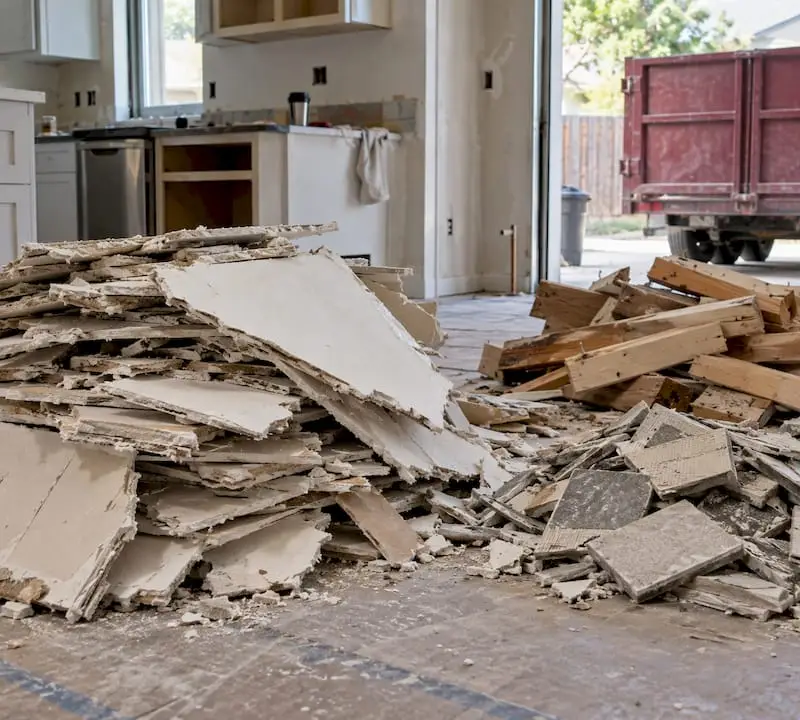
Professional construction debris removal in the US runs about $70.51 to $82.61 per cubic yard, according to Homewyse’s May 2026 national estimate. Most small and mid-size cleanups land in the hundreds of dollars, and the final number depends on volume, material weight, access and disposal fees. In the Denver metro area, we price by trailer load, from $120 for a minimum load to $840 for a full trailer, with labor, loading, haul-away and cleanup included.
This guide shows how the price is built, how to estimate your own load, what a quote usually leaves out, and which Denver rules can affect a project.
TL;DR
- National benchmark: about $70.51 to $82.61 per cubic yard for professional removal (Homewyse, May 2026). That covers local transportation, worksite preparation and typical setup labor.
- Weight drives disposal fees. Concrete, brick and tile are far heavier than drywall or lumber, so a small pile of masonry can cost more than a big pile of scrap wood.
- Standard quotes usually exclude hazardous-material testing, permits and sales tax. Ask what is and is not in the price.
- Our Denver-area pricing is per trailer load: $120 minimum, $240 for a 1/4 trailer, $420 for a 1/2 trailer, $840 for a full trailer.
- You can get an instant quote by sending us a photo of the debris.
Table of Contents
- What counts as construction debris
- The national price range
- What is not in a standard estimate
- How disposal costs are built
- What pushes the price up or down
- Our pricing for the Denver metro area
- Denver rules that can affect your project
- Choosing how to get rid of it
- Perspective
- Get a quote for your debris
- Ways to keep the cost down
- FAQ
- Sources
What counts as construction debris
Construction debris is the material left behind when you build, remodel or tear something out. Common examples:
- Drywall, framing lumber, plywood and trim
- Flooring, tile, carpet and padding
- Cabinets, countertops and old fixtures
- Concrete, brick, block and asphalt
- Roofing material
- Light demolition: sheds, decks and fences
The mix matters because each material is disposed of differently and weighs something different. A kitchen gut-out and a patio demo can be the same size and cost very different amounts to haul.
The national price range
Published guides give a wide spread, because they define the job differently. Homewyse prices debris per cubic yard and shows how much it varies with site conditions and options. Its basic estimate includes local transportation, worksite preparation and typical setup and mobilization labor.
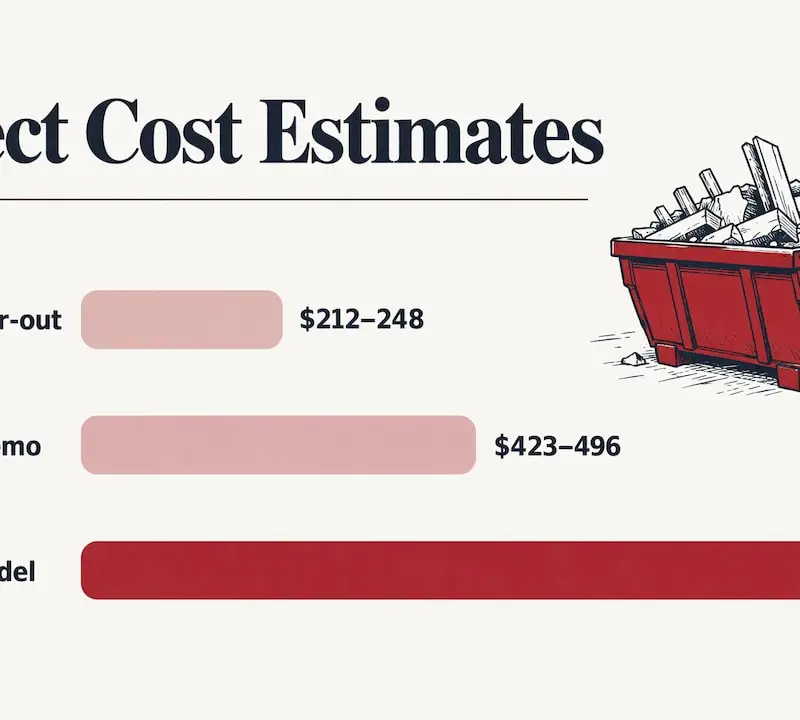
Per-yard pricing is easy to compare, but it hides the thing most homeowners want to know: what the whole job will cost. Here is how that translates for a few common project sizes at the Homewyse per-yard rate:
| Debris volume | Typical project | Estimate at $70.51 to $82.61/yd³ |
|---|---|---|
| 3 yd³ | Small bathroom tear-out | about $212 to $248 |
| 6 yd³ | Deck or shed demolition | about $423 to $496 |
| 10 yd³ | Kitchen remodel | about $705 to $826 |
These are arithmetic on a national average, not quotes. Local labor rates, access and disposal charges move the real number up or down.
What is not in a standard estimate
The same Homewyse estimate excludes hazardous-material testing and remediation, permits, sales tax and general-contractor overhead. It also excludes the cost of removing or modifying framing, finishes, HVAC, electrical or plumbing systems. In plain terms, the price covers hauling debris that is already out of the building, not the work of getting it out.
Two things follow from that:
- If your project might involve asbestos or lead paint, testing and remediation come first and are priced separately by licensed specialists. Hazardous debris is also not something to mix into a regular load.
- If you want one company to demo and haul, ask for the demolition and the haul-away to be written down as separate lines so you can compare them.
How disposal costs are built
The NAHB Research Center’s Builder’s Field Guide breaks waste management into three costs:
- Handling: gathering and carrying waste to the truck or dumpster. The guide puts this at about 2.4 hours per ton.
- Transporting: the truck, its operation and the driver’s labor.
- Tipping: the fee charged by the receiving facility, by volume or by weight.
That third line is why material matters so much. Facilities often charge by weight, while a jobsite is estimated by volume. Bridging the two takes one formula: tons equal cubic yards multiplied by pounds per cubic yard, divided by 2,000.
Estimating weight yourself
Contra Costa County, California, publishes an official volume-to-weight table for construction debris. It lists these approximate densities:
| Material | Pounds per cubic yard |
|---|---|
| Mixed construction debris | 417 |
| Concrete and asphalt | 1,400 |
| Gypsum board (drywall) | 467 |
| Wood | 169 |
| Roofing materials | 731 |
Two worked examples:
- 10 yd³ of mixed debris from a remodel: 10 × 417 = 4,170 lb, or about 2.1 tons.
- 2 yd³ of broken concrete: 2 × 1,400 = 2,800 lb, or 1.4 tons.
The concrete pile is a fifth of the volume but weighs more than half as much as the whole remodel. That is why a driveway or patio demo can cost more than its size suggests, and why we like to see a photo before we quote.
What pushes the price up or down
Volume. The biggest driver by far. Every extra cubic yard adds hauling, loading and disposal.
Material type. Heavy, dense material costs more to dispose of. Mixed loads that combine clean wood with painted or treated pieces can be handled differently than clean, sorted loads, so sorting at the source helps.
Access. Debris in a basement, up a flight of stairs or behind a gate takes more labor than debris stacked at the end of a driveway. Moving it to the curb or driveway before the crew arrives can shorten the job.
Labor. If a job needs extra hands for heavy lifting, we charge additional labor at $50 per hour per crew member.
Special items. Appliances with refrigerant need proper handling. We charge $100 per unit for Freon appliance handling.
Hazardous material. Asbestos and lead debris need licensed handling and are outside a standard junk and debris removal quote.
Our pricing for the Denver metro area
We are a family-owned crew based in Parker, Colorado. We do not run a franchise or a call center. Instead of per-yard math, we charge by how much of our trailer your debris fills. Labor, loading, haul-away and cleanup are included. These are the prices published on our pricing page:
| Load size | Price |
|---|---|
| Minimum / small load | $120 |
| 1/8 trailer | $120 |
| 1/4 trailer | $240 |
| 3/8 trailer | $360 |
| 1/2 trailer | $420 |
| 5/8 trailer | $540 |
| 3/4 trailer | $660 |
| 7/8 trailer | $780 |
| Full trailer | $840 |
What that looks like in practice:
- A few bags of drywall scraps and a vanity from a bathroom update usually fit in the smaller load sizes.
- A torn-out deck or a section of fence is a bigger job, where the half-trailer to full-trailer range is more likely.
- Items such as a hot tub ($400 flat rate for a small tub, $500 flat rate for a standard spa (4–6 people), and $700 flat rate for a large spa or swim spa), a piano (from $375) or a treadmill ($150) are priced individually.
The quote is based on what we see, which is why the process starts with a photo.
Denver rules that can affect your project
If you are working inside the city of Denver, the recycling rules for construction can shape how debris is handled. According to the city’s Community Planning and Development announcement, the Universal Recycling and Composting Ordinance (URCO) took effect on September 1, 2026. It generally covers new construction, additions or demolition projects larger than 500 square feet, and interior remodels larger than 2,500 square feet.
The city’s URCO process guide says qualifying projects must:
- Submit a Waste Diversion Plan through Green Halo before the permit is issued.
- Pay a $105 administrative fee and a refundable deposit.
- Divert at least 50% of debris by weight, across at least three covered materials. These are concrete, asphalt, masonry, untreated wood, metal, corrugated cardboard or reused items.
This mostly concerns the permit holder, usually the general contractor. A homeowner doing a small remodel will often fall below the size thresholds. If you are not sure whether your project qualifies, ask the city’s permitting office or your contractor.
Separating clean, recyclable materials such as untreated wood, metal and concrete at the jobsite helps no matter the rules. It keeps loads simpler and makes disposal easier to plan.
Choosing how to get rid of it
There are three common routes, and each fits a different job.
Hauling it yourself. This suits a small amount of light material if you have a truck, the time and a place that accepts it. You pay for the vehicle, your labor and the disposal fee, and the work is heavy.
A dumpster. This suits a long project that will generate debris for weeks, with space for the container. Plan for loading time and keep an eye on weight, since heavy material fills the weight allowance before the box is full.
Full-service removal. This suits a finished job or a cleanup at a milestone. A crew arrives, loads everything, hauls it away and sweeps up. You pay for the volume taken, and you do not lift anything.
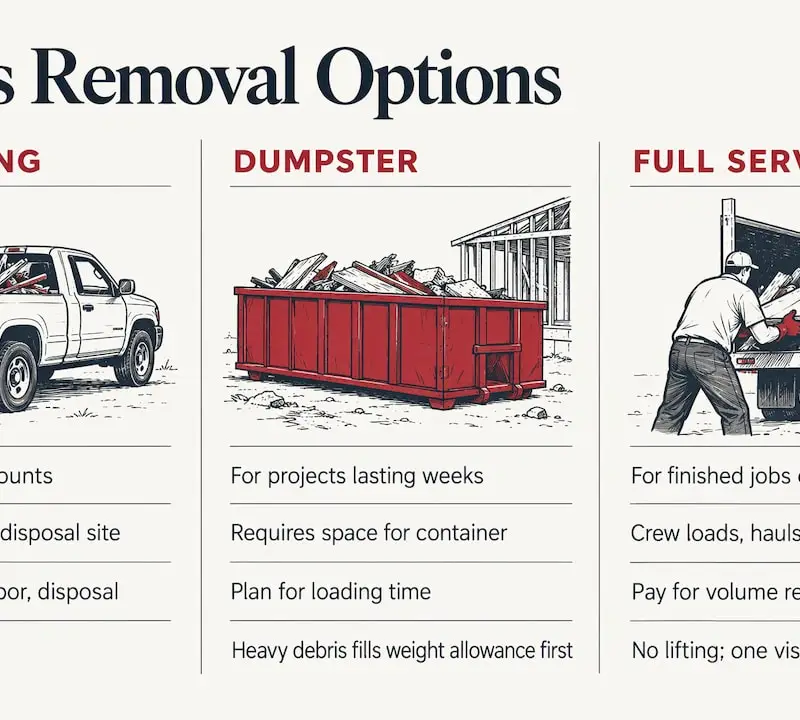
For most homeowners with a finished tear-out, a deck demolition or a garage full of leftover materials, full-service removal is the simplest path. You see the price before anything is loaded, and the work is done in one visit.
Perspective
Most people call us after the demo is finished and the debris is blocking the garage or the driveway. They want a number fast, and they want to know it will not change halfway through the job.
That is why we price by trailer load and quote from a photo. You send us a picture, we tell you where the pile fits on the scale from $120 to $840, and the crew does the lifting, loading and cleanup. We do not tack on surprise fees, and we treat your property with care, because it is your home and our name is on the job.
My advice: sort heavy material like concrete and tile from lighter material if you can, put it somewhere easy to reach, and send the photo before you buy a dumpster or rent a truck. Often the quote is lower than people expect.
Ben
Get a quote for your debris
If you have construction debris in the Denver metro area, send us a photo and we will give you a price based on the load size. Our crew handles the loading and cleanup, and we donate and recycle where we can. See our construction debris removal service for details, or check the full trailer-load price list.

We serve the south and east metro, including Highlands Ranch, Castle Rock, Centennial, Littleton and Denver. If your project also produces landscaping waste, read our guide to yard waste removal costs.
Ways to keep the cost down
- Sort as you go. Keep concrete, metal and clean wood apart from mixed trash. Lighter, simpler loads are easier to handle.
- Stage the debris. Stack it near the driveway or garage, not in a basement or at the back of the yard. Less carrying means less labor.
- Break down what you can. Flattened boxes, cut-up lumber and stacked drywall take less trailer space than a loose pile.
- Combine jobs. If you also have an old mattress, appliances or furniture, ask for them to go in the same visit. Our mattress removal is $150, and washers and dryers are $100 per unit.
- Send a clear photo. Show the whole pile and any stairs or gates. A good photo gives a more accurate quote.
- Keep hazardous materials separate. If you suspect asbestos or lead paint, have them tested before demolition and tell whoever is quoting.
FAQ
How much does construction debris removal cost?
Nationally, Homewyse estimates $70.51 to $82.61 per cubic yard as of May 2026. With us in the Denver area, prices run from $120 for a minimum load to $840 for a full trailer, depending on how much space your debris takes.
How do I estimate how heavy my debris is?
Multiply cubic yards by the material’s pounds per cubic yard, then divide by 2,000 to get tons. Mixed construction debris is about 417 lb per cubic yard and concrete about 1,400, according to Contra Costa County’s table.
Does a removal quote include hazardous waste?
Usually not. Standard estimates exclude hazardous-material testing and remediation, as well as permits and sales tax. If you suspect asbestos or lead, bring in a licensed specialist before demolition.
Do I need to recycle construction debris in Denver?
Qualifying projects in the city of Denver must divert at least 50% of debris by weight under URCO, which took effect September 1, 2026. It generally covers larger projects, so check with the city or your contractor whether yours is included.
Can I get a quote without someone visiting?
Yes. Send us a photo of the debris by text, phone or our online form, and we will quote the load size. Our crew confirms the price before loading.
Sources
- Homewyse: Cost to Remove Construction Debris
- Contra Costa County: Volume to Weight Conversion Table
- City of Denver: URCO announcement
- City of Denver: URCO process guide