
By Ben, EZ Haulaway · Published
Eco-Friendly Junk Removal: What It Means and How to Do It in Denver
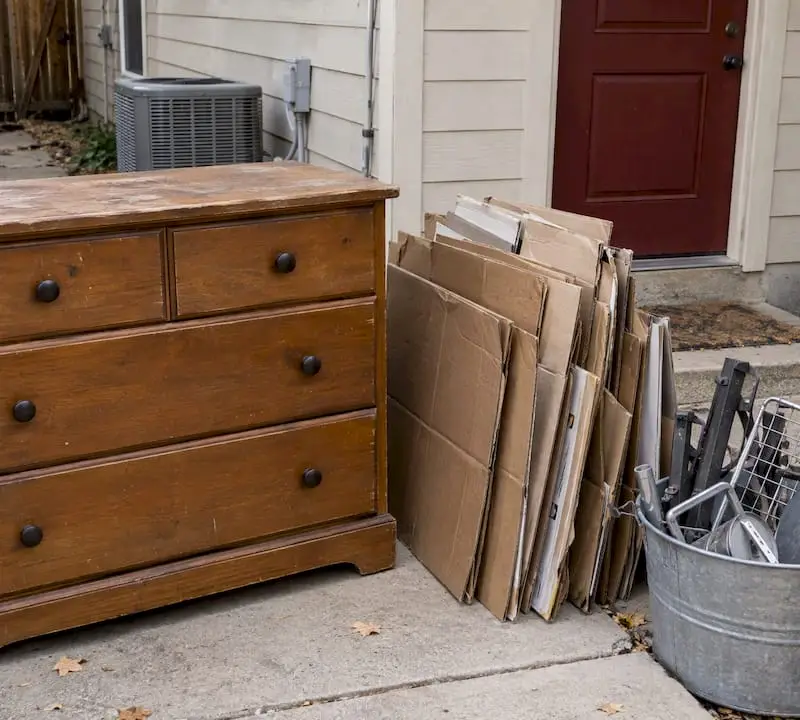
Eco-friendly junk removal means your unwanted items are reused, donated or recycled first, and only what is left goes to a landfill. In the Denver area that comes down to three things: sorting before the truck arrives, sending each item to the right outlet (a donation center, a metal recycler, a certified electronics recycler), and hiring a hauler who can tell you where your load went. This guide explains how it works, what Colorado rules apply, and how to tell real green practice from a green label.
TL;DR
- Green junk removal follows the EPA’s order of priority: reuse and donation first, then recycling, and disposal last.
- In Colorado, TVs, computers, monitors, printers, tablets and similar electronics cannot go in a landfill, and Denver does not take refrigerators or large appliances in its electronics program.
- Refrigerators and AC-type appliances contain refrigerant that must be handled properly, so they should never be dumped or left at the curb.
- Ask any hauler where donations go, how electronics are recycled, and whether the quote includes everything. A vague answer is a warning sign.
- We are a family-owned crew in Parker. You can send us a photo for an instant quote, and we sort for donation and recycling as part of every job.
Table of Contents
- What eco-friendly junk removal actually means
- Before the truck arrives: sort in four piles
- Where donated items really go
- Electronics: what must never go in the trash in Colorado
- Appliances and refrigerant
- What Denver’s own rules ask of you
- How to check whether a hauler is really green
- How we handle eco-friendly junk removal
- Our perspective: green is a process, not a promise
- What eco-friendly removal costs
- Bigger jobs: cleanouts and commercial work
- A simple plan for your next cleanout
- FAQ
- Sources
What eco-friendly junk removal actually means
There is no legal definition of “green” junk removal, so the phrase can mean anything from a serious sorting operation to a sticker on a truck. The most useful yardstick is the EPA’s waste hierarchy. It ranks the options from best to worst: prevention and reuse first, then recycling and composting, then energy recovery, and treatment and disposal last. The agency notes that recycling can reduce the need for new landfills and conserve resources.
Applied to a cleanout, that gives you a simple test. A genuinely eco-friendly hauler:
- Pulls out usable furniture, appliances, housewares and building materials for donation.
- Separates metal, cardboard, wood and yard debris that have a recycling or reuse outlet.
- Routes electronics and appliances to proper e-waste and refrigerant handling.
- Sends to the landfill only what cannot go anywhere else.
The EPA also points out that reusing or donating items counts as source reduction, which can cut emissions, save energy and resources, and reduce pollution. In other words, the best junk is the junk that never becomes waste, which is why donation sits above recycling.
Before the truck arrives: sort in four piles
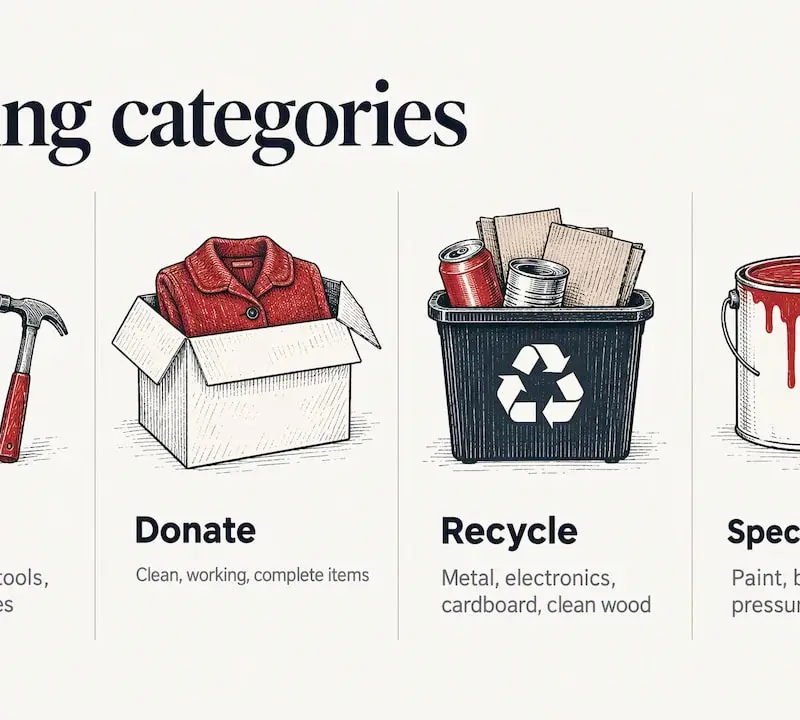
You do not need to do a full cleanout yourself, but ten minutes of sorting changes where your items end up. Walk through the space and make four rough piles.
Keep or sell. Anything with real resale value, such as quality furniture, tools or working appliances. The EPA suggests selling or donating appliances, tools, clothes, books, working electronics and furniture through churches, community centers, thrift stores, schools or nonprofits.
Donate. Clean, working, complete items. The more usable they are, the more likely a charity will actually accept them.
Recycle. Metal, appliances, electronics, cardboard, clean wood and yard waste.
Special handling. Paint, cleaners, automotive fluids, batteries, bulbs and pressurized canisters. These are household hazardous waste and should not be mixed into a junk load. The EPA recommends looking for community household hazardous waste collection days for cleaners, paints and automotive supplies.
If you are also getting ready for a move, general guidance on packing and moving tips can help you decide what is worth carrying to a new place and what should leave now.
Property managers and businesses can go one step further. EPA guidance for commercial buildings says to prevent waste first, then reuse, donate, recycle and compost, and it counts repairing, refurbishing or washing used appliances, furniture and building materials as reuse. It also advises identifying local accepted materials, hauler services, end markets and donation outlets before you expand a program. The Building Owners and Managers Association adds that a waste audit helps identify contamination and measure what you actually throw away, and recommends separate collection for electronics, batteries, light bulbs and plastic film, plus donating usable office furniture.
Where donated items really go
Donation is the highest-value outcome after prevention, but it only works if the item is wanted. Two examples show what charities look for.
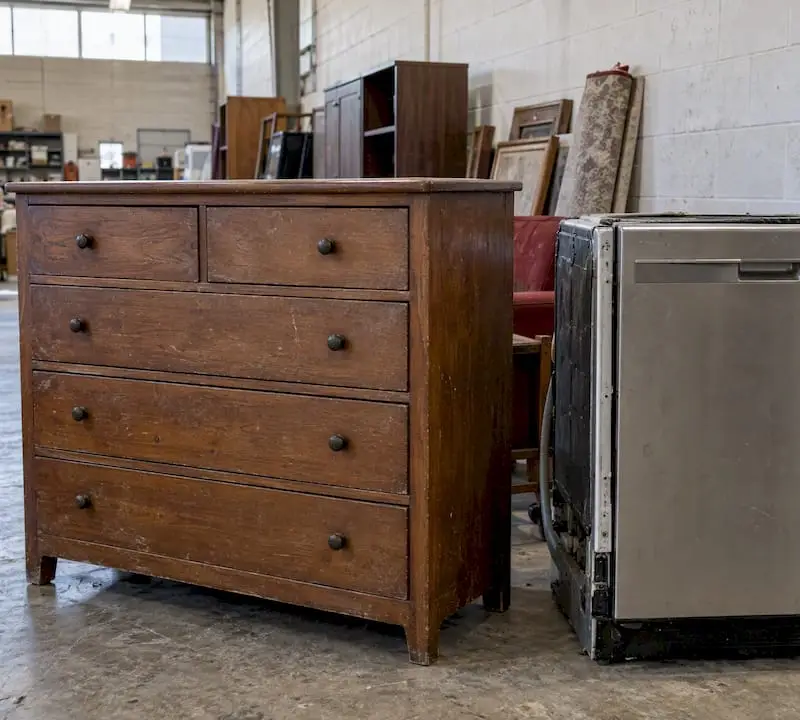
Habitat for Humanity ReStores accept new or gently used furniture, appliances, building materials and household goods, and many offer free pickup of large items. Each store is different, and the sales fund Habitat’s home building. In metro Denver, the local ReStore says all donations must be approved by staff and that it does not accept non-working appliances, used batteries, electronics, fluorescent lighting, mattresses or paint. Plan around that: a working dishwasher or solid dresser is a good candidate, a broken one is not.
Goodwill takes kitchenware, small appliances, bedding, furniture, home décor and many electronics, but rules vary by location, so check with your local store before loading the car.
The practical point: donation outlets are selective. A hauler who says “everything gets donated” is overpromising. A hauler who says “we pull what is donatable, and here is where it goes” is describing how it really works.
Electronics: what must never go in the trash in Colorado
This is the area where eco-friendly removal is also a legal matter. Colorado bans covered electronics from landfills. Denver lists televisions, computers, monitors, peripherals, printers, fax machines, laptops, tablets, DVD and VCR players, radios, stereos, game consoles and screens over four inches as covered, and says the ban has applied since July 1, 2013. Recycle Colorado confirms that residential and non-residential waste electronics must go to a legitimate recycler or collection event.
Some useful details:
- Working electronics can be donated or resold. For unwanted ones, the Colorado Legislative Council lists community events, manufacturer take-back programs, certain retailers and reputable recyclers, and warns that fees may apply.
- Wipe your data first. Both the EPA and the Colorado brief advise removing personal and financial information before you hand a device over. The Colorado brief adds that recyclers are not liable for data you leave behind. See the EPA’s guidance on common recyclables.
- Batteries need their own route. The EPA says lithium-ion, lithium-metal, lead-acid and other rechargeable batteries should stay out of household bins. Use in-store collection bins or a hazardous waste program, and return large EV or storage batteries to the manufacturer, dealer or installer.
- Denver’s program has limits. It does not accept air conditioners, refrigerators, large appliances, garbage disposals, humidifiers, smoke or carbon monoxide detectors, pressurized canisters, fluorescent bulbs, neon signs or any kind of battery.
We handle electronics and e-waste removal so that old monitors, printers and computers do not end up in a bin they are not allowed in. For offices, our Denver office cleanout guide goes through the e-waste types businesses cannot landfill.
Appliances and refrigerant
Big appliances are mostly steel, which is highly recyclable, and that is exactly why they should not be landfilled. Refrigerators, freezers and similar units are the catch: they contain refrigerant such as Freon. Denver says its appliance collection is designed so that metals are recycled and Freon is handled in an environmentally safe manner. Cutting into a fridge or dumping it releases that refrigerant, so a refrigerant-aware pickup matters.
Here is what appliance removal costs with us, as listed on our site:
| Item | Price |
|---|---|
| Refrigerator removal | $150 |
| Washer or dryer | $100 each |
| Freon appliance handling | $100 |
| Mattress removal | $150 |
| Treadmill removal | $150 |
You can see the details on our refrigerator and appliance removal page, or the local version for appliance removal in Denver.
What Denver’s own rules ask of you
Even when you hire a hauler, city rules shape what is possible. Denver’s January 9, 2025 rules for trash, recycling and compost ask residents to follow City collection schedules and accepted-item lists, keep plastic bags out of recycling and compost carts, and use authorized large-item and appliance collection. The same document encourages reduction, reuse and recycling through curbside programs, recycling centers and partner organizations that divert usable appliances, electronics and household hazardous waste.
Two takeaways for a cleanout:
- Curbside carts are for routine household waste, not for a garage full of furniture. Overfilled or contaminated carts defeat the purpose of recycling.
- If you live outside the city of Denver (Parker, Centennial, Littleton, Lone Tree, Highlands Ranch), your own municipality or HOA may set different rules. Check before you set anything out.
How to check whether a hauler is really green
Many companies say “eco-friendly”. Few can prove it. Before you book, ask these questions, and expect specific answers.
- Where do donations go? A real answer names the kinds of organizations or stores that accept items, not just “charity”.
- What happens to electronics? You want to hear that they go to a recycler, not to the general dump. Colorado law requires it for covered devices.
- How do you handle refrigerators? The answer should mention refrigerant.
- Is the quote all-in? Labor, loading, hauling and cleanup should be in the price. Extra fees for “recycling” or “disposal” later on are a red flag.
- Who shows up? A local crew that answers the phone usually knows its outlets better than a dispatch line routing to a subcontractor.
- Can I see it? Reputable crews will tell you what they pulled for donation and recycling from your load.
No single directory certifies junk haulers as green, so the best check is conversation. If a company gets vague when you ask where things go, assume the answer is the landfill.
How we handle eco-friendly junk removal
We are a family-owned company based in Parker, serving the Denver metro area. We are not a franchise or a call center, so the people who quote your job are the people who carry it out. Here is how that works in practice.
Photo quote first. You send a photo of what you want gone through our instant estimate page, and we quote the job. Our how it works page walks through the steps from quote to cleanup.
Sorting on site. Labor, loading, haul-away and cleanup are included in the price. As we load, usable items are separated for donation and recyclable materials for recycling, and we take everything from furniture and appliances to yard debris. You can see the full list on what we take.
Care for your property. We treat your home or building with respect and sweep up when we finish.
Our perspective: green is a process, not a promise
We get asked about eco-friendly removal almost every week, and the honest answer is that most of the impact is decided before the truck backs in. A couch with a ripped cushion will not be accepted by most donation outlets, a fridge with refrigerant needs specialized handling, and an old monitor has to go to an e-waste recycler. None of that is glamorous, and none of it can be faked with a logo.
What we believe is simple. Give people an easy way to get rid of things, and they will not leave a mattress in an alley or a TV in a dumpster. The easier we make the photo quote and the pickup, the fewer items end up dumped. Then it is our job to sort what we collect, send what can be used to donation, and keep what must be recycled out of the landfill. We do not claim everything we haul is saved, because it is not. We do claim that we look at every load with the question, “Where can this go instead of the dump?”
If you are not sure what is worth donating or how something should be handled, send us the photo and ask. We would rather answer a quick question than see a good item wasted.
— Ben
What eco-friendly removal costs
Green practices do not mean a premium price from us. We price by how much space your items take in our trailer, and the rates below are the ones listed on our pricing page:
| Load size | Price |
|---|---|
| Minimum / small load | $120 |
| 1/8 trailer | $120 |
| 1/4 trailer | $240 |
| 3/8 trailer | $360 |
| 1/2 trailer | $420 |
| 5/8 trailer | $540 |
| 3/4 trailer | $660 |
| 7/8 trailer | $780 |
| Full trailer | $840 |
Specialty items are priced separately: hot tub removal runs $400 flat rate for a small tub, $500 flat rate for a standard spa (4–6 people), and $700 flat rate for a large spa or swim spa, couch removal is $150 for a 2–3 seat couch, $250 for a sleeper, and $350 for a large sectional, and piano removal starts from $375. If a job needs more hands, additional labor is $50 per hour per crew member. For hot tubs, see our hot tub removal page.
A tip for keeping costs and waste down: donate or sell the good items yourself if you have time, and let us take the rest in a smaller load. The less volume, the lower the trailer fraction.
Bigger jobs: cleanouts and commercial work
Eco-friendly removal matters most on large projects, because that is where the volume is. For a house or estate cleanout, the gains come from sorting: furniture, housewares and building materials with life left in them go one way, and true trash goes another. Storage units follow the same logic, and our storage unit cleanout service is built for it.
For property managers and offices, commercial junk removal works best with advance planning. Tell us what is coming out (desks, chairs, monitors, appliances from a break room), and we can plan donation and e-waste routes before pickup day. We do not publish a price for house and estate or commercial jobs, since they depend on volume and scope, so the quote comes from a photo or walkthrough.
A simple plan for your next cleanout
- Walk through and sort into keep, donate, recycle and special-handling piles.
- Wipe data from phones, laptops and tablets, and take out batteries.
- Take hazardous items such as paint and cleaners to a community collection event.
- Photograph what is left, including large items and appliances.
- Get a quote from a local hauler and ask the six questions above.
- Book a time, and be sure items are accessible so the crew can load quickly.
If the list feels like a lot, start with step 4. A photo to our team gets you a number, and we can tell you what we see as donatable.
FAQ
Is eco-friendly junk removal more expensive?
Not necessarily. Sorting and donating takes effort, but it does not have to change the price you see. Our pricing is by trailer load or by specific item, with labor, loading, haul-away and cleanup included. You can lower the cost by removing sellable or donatable items before we arrive.
Can you recycle a TV or computer in Colorado?
Yes, and you are required to. Covered electronics such as TVs, monitors, computers and printers cannot go to Colorado landfills. They should go to a legitimate recycler or collection event, and you should wipe personal data first. We can pick them up as part of a job.
What happens to a refrigerator when it is removed?
A refrigerator contains refrigerant that has to be handled in an environmentally safe way, and its metal can be recycled. Denver’s own appliance collection is designed around those two goals. Our fridge removal is $150, with a $100 per unit Freon handling fee.
Will a charity take my old furniture?
Sometimes. Donation centers accept clean, usable items and decline damaged ones. Some, like the Denver ReStore, will not take mattresses or non-working appliances. Check with the organization first, or send us photos and we will tell you what looks donatable.
How do I know a junk removal company is really green?
Ask where donations go, how electronics are recycled and how refrigerators are handled, and confirm the quote is all-in. A reliable company will answer plainly. If it only offers slogans, keep looking.
Sources
- EPA: Non-hazardous materials and waste management hierarchy
- EPA: What you can do
- EPA: How do I recycle common recyclables
- EPA: Managing and reducing wastes, a guide for commercial buildings
- BOMA: Waste Management Improvement Guide
- Habitat for Humanity: donate goods to ReStore
- Habitat for Humanity of Metro Denver: donate items
- Goodwill: donate goods
- City and County of Denver: electronic recycling
- City and County of Denver: appliance collection
- Denver rules and regulations for trash, recycling and compost (2025)
- Colorado Legislative Council: electronic device recycling issue brief
- Recycle Colorado: recycling basics
- ShipShape Moving: tips and tricks