
By Ben, EZ Haulaway · Published
Furniture Disposal in Denver: Every Option, Cost and Rule
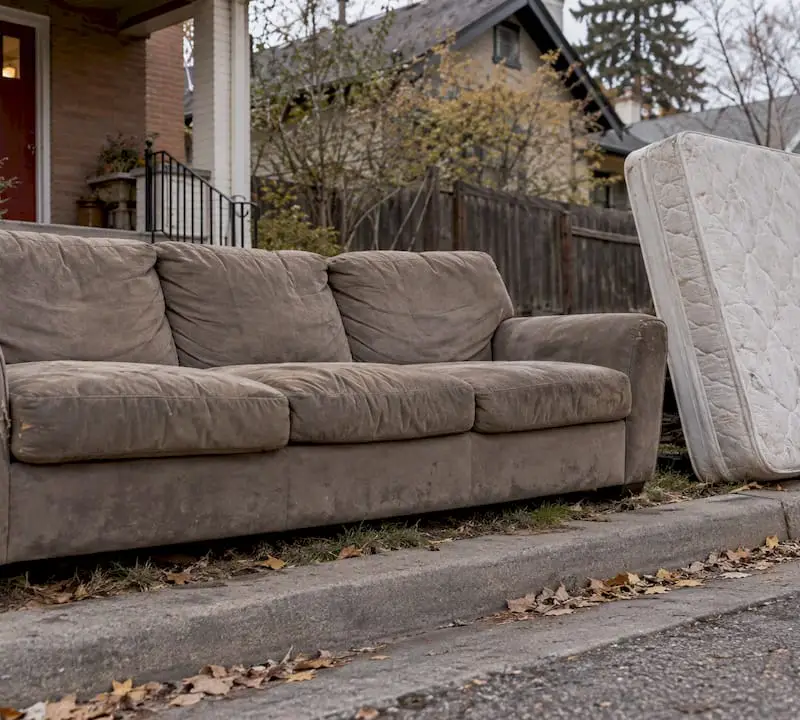
You can get rid of old furniture in Denver four ways: the city’s Large Item Pickup, a drop-off at a private facility, a donation, or a hauler who comes to your door. Which one fits depends on the condition of the piece, how much of it you have, and how soon it has to be gone. This guide walks through each route with the rules, the costs and the catches, so you can pick one and be done.
TL;DR
- Denver’s Large Item Pickup is the cheapest route, but it runs only every nine weeks and takes a maximum of five large items per address.
- Donation centers want clean, resellable furniture. Stained, torn or broken pieces and mattresses usually go to disposal or recycling instead.
- Paid haul-away is the fast option. With us, a single couch is $150 for a 2–3 seat couch, $250 for a sleeper, and $350 for a large sectional and a mattress is $150, and larger loads are priced by trailer space.
- Prepare early: items must be visible, out by 6 a.m., and at least 2 feet clear of carts, cars and poles.
Table of Contents
- Your furniture disposal options in Denver at a glance
- Denver’s Large Item Pickup: how it works
- Drop-off facilities: cheap if you have a truck
- Donating or recycling a couch and other furniture
- What furniture removal costs in Denver
- How to prepare your furniture for removal
- A paid pickup, and when it makes sense
- Our perspective: what we see on the job
- Choosing the right route: a quick decision guide
- FAQ
- Sources
Your furniture disposal options in Denver at a glance
Most people stall on this because the choices look similar. They are not. They differ in timing, effort and what they accept.
| Option | Best for | Cost | Main catch |
|---|---|---|---|
| City Large Item Pickup | A few pieces, no rush | Included with city trash service where eligible | Every nine weeks, five-item limit |
| Private drop-off facility | You have a truck and a free afternoon | Fee, set by the facility | You load, drive and unload |
| Donation drop-off or pickup | Clean, usable pieces | Free at attended centers | Strict condition rules |
| Full-service junk removal | Heavy pieces, stairs, tight deadlines | Per item or per trailer load | Costs more than doing it yourself |
Denver’s Large Item Pickup: how it works
The city collects bulky items on a schedule. According to Denver’s Large Item Pickup page, it happens every nine weeks on the same day as your regular trash and recycling collection. The city takes up to five large items, furniture included, plus up to 10 bags, from each service address.
The rules matter more than the schedule:
- Items must be out by 6 a.m. on your normal collection day.
- Items must be visible from the street.
- Place them at least 2 feet away from carts, cars, poles and other obstructions, so the truck can reach them.
If your couch sits behind a cart or under a tree branch, the crew can skip it. Put it at the curb the night before and walk the line yourself.
This route has two weaknesses. First, you wait for your window. Move out Friday and your next pickup is five weeks away? Then it will not help. Second, the five-item cap is real. A full living room, a bedroom set and a dining table can blow through it quickly. Not every address is eligible either, since some buildings and multifamily properties are served by private haulers, so check with the city or your property manager before you drag a sectional to the curb.
Drop-off facilities: cheap if you have a truck
If you cannot wait nine weeks, the city also lists private drop-off facilities in the metro area that accept household trash and large items such as furniture and mattresses for a fee. The same city page advises calling ahead to confirm hours and fees. Do that. Fees are set by each facility, and some price by weight or by vehicle load.
Be honest about the work involved. A sofa has to get down your stairs, into a truck or trailer, across town and out again at the other end. Two people and a ratchet strap are the minimum, and hauling in an open truck bed comes with its own risk of an unsecured load. For a single small chair, drop-off is fine. For a sleeper sofa on the third floor, it is a bad Saturday.
Denver also keeps a list of licensed haulers, which is worth checking before you hire anyone who answers a social media post offering cheap pickup. A hauler who dumps your couch in an alley leaves you with a problem, and sometimes with a fine.
Donating or recycling a couch and other furniture
Donation feels like the right answer, and for good pieces it is. For worn pieces, it usually is not.
What charities accept. Goodwill of Colorado accepts furniture in gently used, resellable condition. It does not take broken, stained or worn furniture, and it does not accept mattresses, box springs or bed pillows. Its attended donation centers do not charge. Goodwill also describes a fee-based home pickup through a partner that can take items in any condition, and says it does not receive those pickup fees.
The arc Thrift Stores residential pickup is stricter. Per its donation page, furniture must be in good, immediately reusable condition, with no stains, rips, tears or pet hair. Items need to be outside at ground level, and the driver has final say on what goes on the truck.
A simple test: if you would be comfortable giving it to a friend, donate it. If you would apologize while handing it over, it is not a donation.
Couch recycling. People search for this a lot, and the honest answer is that couches are hard to recycle. They are a mix of foam, fabric, wood frames and metal springs, and few facilities break them down. In practice a worn couch ends up in the city’s large item collection, at a drop-off facility or on a hauler’s truck. The city’s page also points residents to the Waste Directory to look up donation outlets for specific items, which is a good place to find a local reuse option for pieces like bookshelves, tables and dressers.
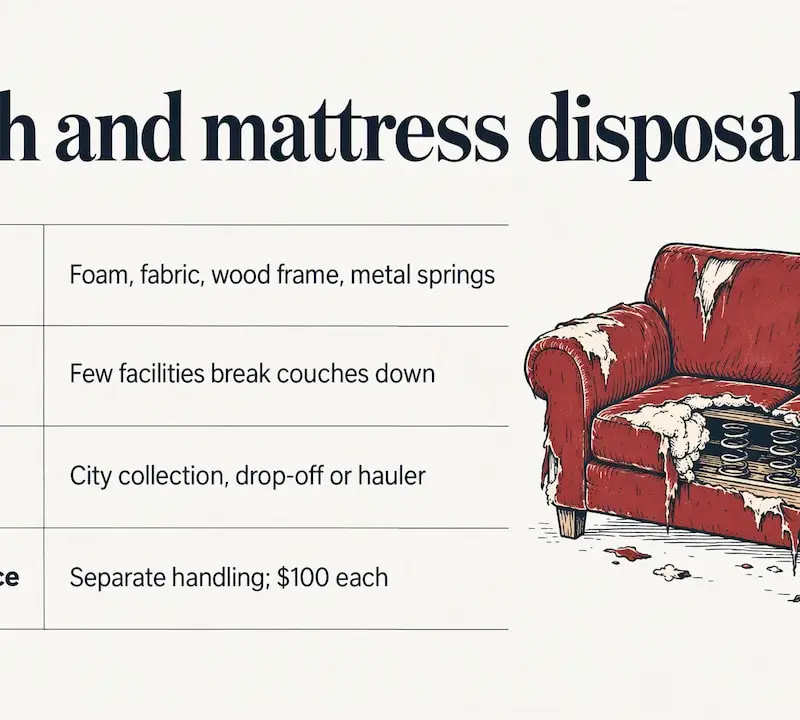
Mattresses are the exception most people miss. Charities decline them, and they take up a lot of room in your five-item city allotment. If you have one, plan for it separately. Our mattress and bulky item removal service handles them for $150 each.
What furniture removal costs in Denver
Cost is the question every reader asks, and prices vary widely. A cost guide from Angi puts the average junk removal job in Denver at $196, with a typical range of $107 to $286. It lists bulky furniture at $85 to $425 per piece. That is a wide band, and it is wide for a reason.
What moves the price:
- Volume. Most professional haulers charge by how much space your items take in the truck. Ten small items can cost less than one oversized sectional.
- Weight and material. Solid wood, sleeper sofas and recliners are heavy. Disposal itself costs money, and the same Angi guide notes local landfill fees of $50 to $100 per ton.
- Access. Stairs, long carries, tight hallways and elevators add labor.
- Special handling. Pieces that need disassembly, or that contain appliances or electronics, can carry added charges.
- Timing. Same-week or same-day service often costs more than a flexible slot.
The lesson: get a quote that is built from your actual items, not a phone guess.
Our prices for common furniture pieces
We publish our rates on our pricing page, and labor, loading, haul-away and cleanup are included. For individual pieces:
| Item | Price |
|---|---|
| Couch | $150 for a 2–3 seat couch, $250 for a sleeper, and $350 for a large sectional |
| Mattress | $150 |
| Piano | starting at $375 |
| Treadmill | $150 |
A 2–3 seat couch is $150. A sleeper couch is $250. A large sectional is $350. A recliner or loveseat is $125.
Pricing for bigger loads
When you have a mix of items, such as a couch, a dresser, a table and some boxes, trailer space is usually the better measure:
| Load size | Price |
|---|---|
| Minimum / small load | $120 |
| 1/8 trailer | $120 |
| 1/4 trailer | $240 |
| 3/8 trailer | $360 |
| 1/2 trailer | $420 |
| 5/8 trailer | $540 |
| 3/4 trailer | $660 |
| 7/8 trailer | $780 |
| Full trailer | $840 |
If the job needs extra hands, additional labor is $50 per hour per crew member. If an appliance contains Freon, there is a $100 per unit handling fee. Check the pricing page before booking, since rates can change.
How to prepare your furniture for removal
A little prep saves money and prevents skipped items, whichever route you choose.
- Decide what goes where. Sort into donate, haul and keep before anyone arrives. Clean, resellable pieces go to donation. Everything else goes to the disposal route you picked.
- Empty it. Pull out drawers’ contents, bookshelf items and anything hiding in couch cushions.
- Clear a path. Measure doorways, move rugs and open every door between the piece and the exit.
- For city pickup, set items out by 6 a.m. on your collection day, visible, with at least 2 feet of clearance around each item, as the city requires. Count your items. Five is the limit.
- For donation pickup, put pieces outside at ground level, as the charities ask, and expect the driver to decline anything worn.
- For a hauler, take a few clear photos of everything that is going. That is all we need for a quote.
A paid pickup, and when it makes sense
Paying someone is the right call in more cases than people expect. It makes sense when:
- you have a hard deadline, such as a closing, a move-out inspection or a landlord’s walkthrough;
- the pieces are heavy, awkward or on upper floors;
- you have more than five items, or you missed your city window;
- you are clearing a whole room, garage or estate rather than one couch;
- you manage a property and need units turned over fast.
Our furniture removal service in Denver works like this: send us photos, get a quote, pick a time, and our crew does the lifting, loading and sweep-up. You can start with our instant online estimate, and no one needs to be on a call or at home measuring.
If you are clearing out an entire home, our house and estate cleanout service is built for that, and businesses and landlords can look at our commercial junk removal page. For a general idea of what we haul beyond furniture, see what we take.
Our perspective: what we see on the job
We are a family-owned crew based in Parker, and we work across the Denver metro area. We are not a franchise and there is no call center between you and the people who show up. That shapes how we think about furniture.
The first thing we see is that most people overestimate how much of their furniture can be donated. Charities are selective, and rightly so, because they have to resell what they take. A couch with a stained cushion or a dresser with a broken drawer rarely qualifies. We would rather tell you that up front than have you hold a piece for three weeks waiting on a pickup that never comes.
The second thing is that the city’s pickup is a good program with a calendar that does not fit real life. Moves, estate sales, flooding and divorces do not wait nine weeks. If your timeline is flexible and you have fewer than five items, use it. Seriously. It is the cheapest option.
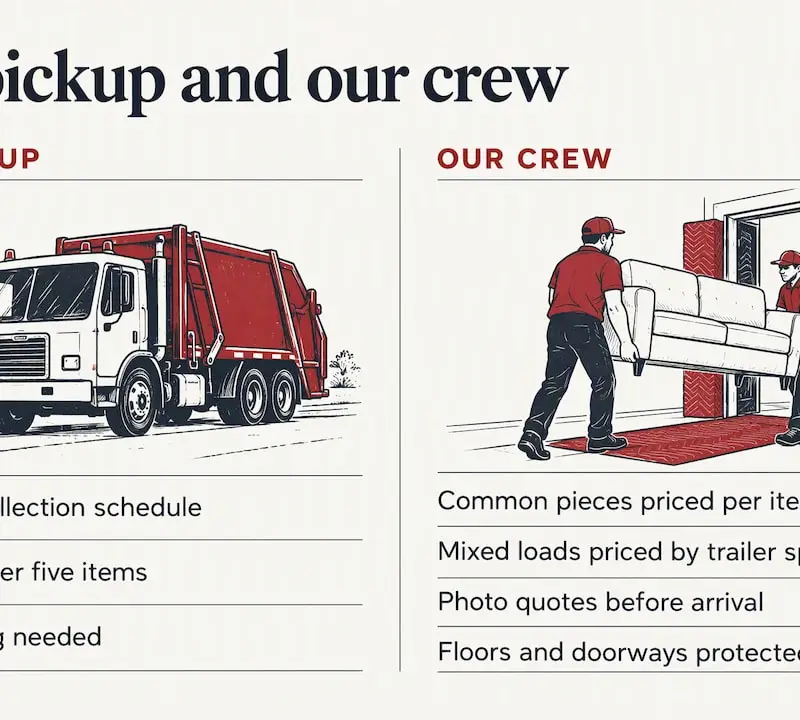
The third is that price should be easy to understand. We charge by item for common pieces and by trailer space for mixed loads, and we publish both. Photo quotes exist so that you know the number before we arrive, and we keep the work respectful of your property: we protect floors and doorways, and we clean up after loading.
Where we can, we donate and recycle usable items instead of sending everything to disposal. Tell us if you have pieces in good shape and we will sort them out as part of the job.
— Ben
Choosing the right route: a quick decision guide
- One or two worn pieces, no deadline: Denver’s Large Item Pickup.
- Good-condition furniture: a donation center, or a pickup if your piece meets the charity’s rules.
- A few items and a truck: a private drop-off facility, after a call about fees.
- A mattress, a heavy sectional or a stairs situation: a hauler.
- A full room, garage or home: a trailer-load quote or a cleanout service.
Whatever you choose, handle it a week before you need the space back. Pickup windows and charity schedules fill up, and the last-minute scramble is where people overpay.
FAQ
How do I dispose of a couch in Denver?
Put it out for the city’s Large Item Pickup, which comes every nine weeks with your trash day, or take it to a private facility that accepts large items for a fee. If it is clean and in good shape, a charity may take it. If you need it gone quickly, a hauler can remove it, and we charge $150 for a 2–3 seat couch, $250 for a sleeper, and $350 for a large sectional.
Does Denver pick up old furniture for free?
The city collects large items such as furniture every nine weeks, up to five large items and 10 bags per service address, as described on the city’s page. Eligibility depends on whether the city serves your address, so confirm with Denver Solid Waste Management or your property manager. Items must be out by 6 a.m., visible and clear of obstructions.
Can I donate a worn or stained couch?
Usually not. Goodwill of Colorado says it does not accept broken, stained or worn furniture, and arc Thrift asks for furniture in immediately reusable condition. Worn pieces are better off going through city pickup, a drop-off facility or a hauler.
What happens to my old mattress?
Charities generally do not accept mattresses or box springs. You can put a mattress into the city’s large item collection, where it counts toward your five-item limit, or pay for removal. We take mattresses for $150 each.
Sources
- Large Item Pickup, City and County of Denver
- Licensed Haulers, City and County of Denver
- About Donating, Goodwill of Colorado
- arc Thrift Stores Donations
- How Much Does Junk Removal Cost in Denver, CO?, Angi