
By Ben, EZ Haulaway · Published · Updated
Junk Removal Cost: What You’ll Pay in Denver in 2026
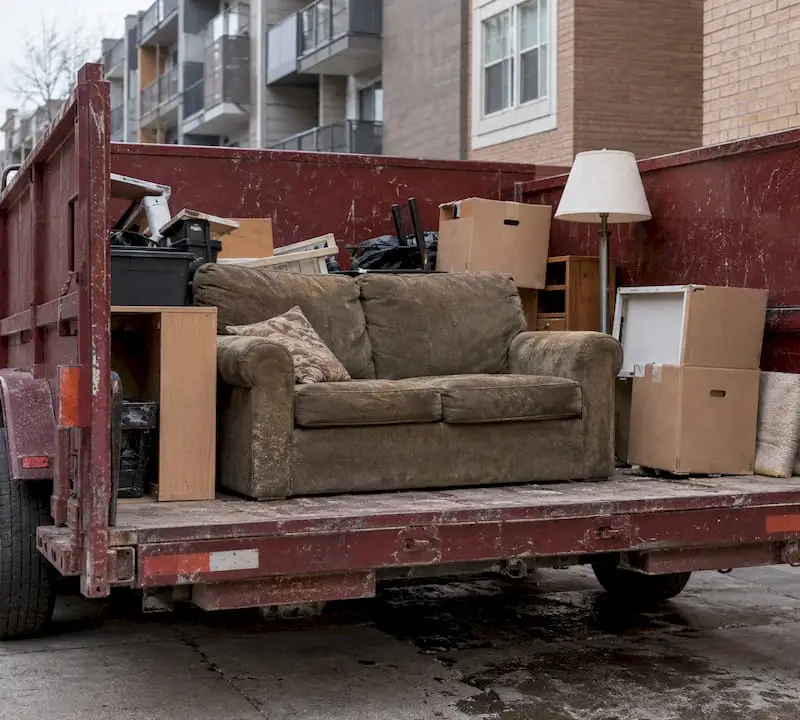
Junk removal usually costs between about $100 and $800 per job, and the biggest driver is how much space your stuff takes up in the truck or trailer. In Denver and the south metro, our own published rates run from $120 for a minimum load to $840 for a full trailer, with labor, loading, haul-away and cleanup included. Below you’ll find the national picture, our full price list, what pushes a quote up, cheaper alternatives, and how to lock in a number before anyone shows up.
TL;DR
- Most junk removal is priced by volume: the share of a trailer or truck your items fill. Single bulky items often carry flat fees.
- Our Denver-area trailer-load pricing starts at $120 (minimum load) and tops out at $840 for a full trailer.
- Appliances with refrigerant, hot tubs, pianos and heavy debris cost more than ordinary household junk.
- Renting a dumpster or hauling it yourself can look cheaper, but you pay in time, labor, dump fees and a lot of heavy lifting.
- Send us a photo and we’ll quote you before the crew arrives, through our instant estimate page.
Table of Contents
- What junk removal costs nationally
- How junk removal companies set their price
- Our Denver-area price list
- Worked examples
- What makes a junk removal quote go up
- Cheaper ways to get rid of junk, and the trade-offs
- Our perspective: why we quote from photos
- How to get an exact quote before you book
- Costs for homes versus businesses
- What’s usually included, and what to double-check
- FAQ
- Sources
What junk removal costs nationally
Across the U.S., a full truckload of junk, roughly three to four pickup-truck loads, typically costs between $600 and $800. Smaller jobs cost proportionally less, and most companies set a minimum charge so that sending a truck and crew is worth the trip.
That is why you see wildly different numbers online. A “$99 junk removal” ad is usually a minimum or a single-item special. A “$800 junk removal” figure is a full truck. Both can be true for the same company on different days. The useful question is not “what is the average?” but “how much of a truck will my stuff fill, and does anything on the pile need special handling?”
Market pricing also moves with local conditions: labor rates, fuel, and what the local landfill or transfer station charges. Denver-metro prices differ from a small Midwestern town, which is why a local price list beats a national average when you’re budgeting.
How junk removal companies set their price
There are three common pricing models, and knowing which one you’re being quoted saves you from comparing apples to oranges.
By volume (the most common)
The company measures how much space your items occupy in the truck or trailer, in fractions: an eighth, a quarter, half, full. Volume is the main way junk removal companies calculate rates, with flat fees for single items and hourly or weight-based pricing for heavy, labor-intensive debris. This is how we price: you pay for the space your junk takes, not for the number of items or how long it takes us to carry them out.
By item
For a single couch, mattress or appliance, a flat per-item fee is simpler. It’s fair when you only have one or two things. Once you have a handful of items, a volume-based load is often cheaper than adding up individual fees.
By weight or by hour
Dense material like concrete, soil, roofing and brick weighs far more than its size suggests, so some companies charge by weight or add hourly labor. Labor is the largest expense in the business, which is why hourly crew time shows up in quotes for jobs that involve long carries, stairs or sorting.
Our Denver-area price list
We’re a family-owned crew based in Parker, serving the Denver metro area. These are the rates published on our pricing page. Each includes the labor, the loading, the haul-away and the cleanup.
| Load size | Price |
|---|---|
| Minimum / small load | $120 |
| 1/8 trailer | $120 |
| 1/4 trailer | $240 |
| 3/8 trailer | $360 |
| 1/2 trailer | $420 |
| 5/8 trailer | $540 |
| 3/4 trailer | $660 |
| 7/8 trailer | $780 |
| Full trailer | $840 |
A few things worth noticing in that table. The jump from the minimum to a full trailer is $720 so a half-full trailer is a bit more than half the price of a full one. And if you’re sitting between two sizes, tidying your pile into a tighter stack before we arrive can occasionally keep you in the lower bracket.
Per-item and specialty pricing
Some things are better priced on their own than by trailer space:
| Item | Price |
|---|---|
| Couch | $150 for a 2–3 seat couch, $250 for a sleeper, and $350 for a large sectional |
| Mattress | $150 |
| Refrigerator | $150 |
| Washer or dryer | $100 each |
| Treadmill | $150 |
| Piano | starting at $375 |
| Hot tub | $400 flat rate for a small tub, $500 flat rate for a standard spa (4–6 people), and $700 flat rate for a large spa or swim spa |
Refrigerator pricing is on our appliance removal page. Appliances that contain refrigerant, such as refrigerators, freezers and air conditioners, carry an extra $100 per unit Freon handling fee. Extra labor, when a job needs more hands than usual, is $50 per hour per crew member.
Hot tubs have the widest range because they vary from a small plug-in spa that rolls out easily to a large cement-pad model that has to be cut up. Our hot tub removal page explains how that works.
For house cleanouts, estate cleanouts and commercial jobs we don’t publish a flat price, because the volume varies so much. You can see how we handle cleanouts and get a figure from a photo or walkthrough.
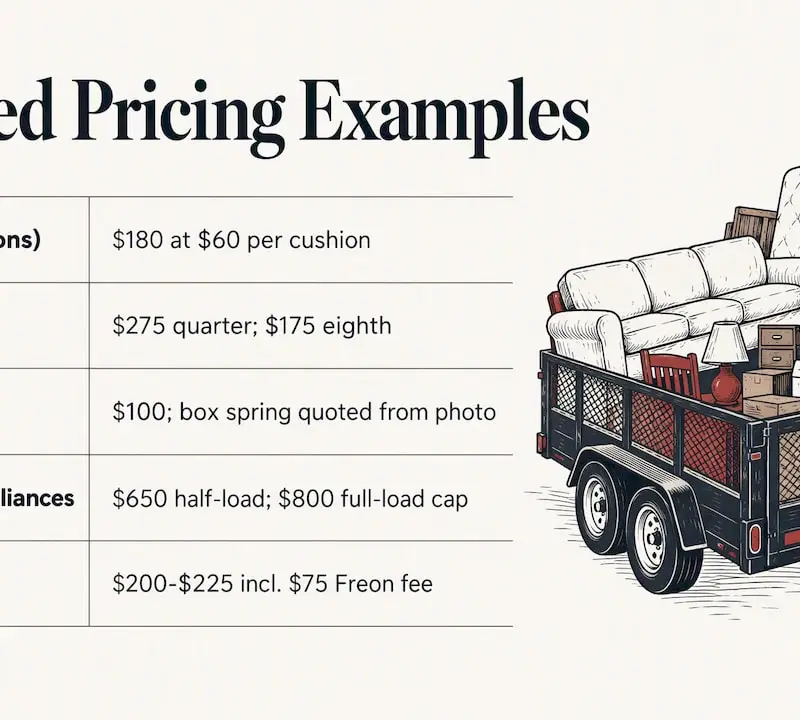
Worked examples
Numbers are easier to trust with real scenarios. These use our published rates.
One old couch with three cushions. A 2–3 seat couch is $150. A sleeper couch is $250. A large sectional is $350. If you also have a couple of boxes and a lamp to go with it, the minimum load at $120 would cover the boxes and lamp but the couch is priced as a whole couch, not by the cushion, so ask us to quote the combination from a photo.
A garage corner of boxes, a shelving unit and a broken bike. This is typically a quarter-trailer job, $240, or an eighth at $120 if it’s really just a few things.
Mattress and box spring after a move. A mattress is $150. Send a photo of both pieces so we can confirm how we’ll price the box spring.
A full basement of old furniture, a washer and a dryer. The washer and dryer are $100 each, and the furniture is priced by how much trailer it fills. If the furniture fills half a trailer, that’s $420 plus $200 for the pair, so $620 total. Compare that with a full trailer at $840 which is the ceiling for anything we can fit in one load.
A refrigerator. $150 for the haul-away plus the $100 Freon handling fee, so $250 all in. We’ll tell you which end of the range applies when we see a photo.
All of these are illustrations of how the price list adds up, not a quote. Your actual number depends on what we see.
What makes a junk removal quote go up
Six things move the price more than anything else.
- Volume. The single biggest factor. Bulky, awkward items like sectionals, bed frames and sheds take more trailer space than their weight suggests.
- Weight and material. Concrete, dirt, shingles and wet debris are heavy. Dense material can be priced differently from household junk.
- Special handling. Refrigerant appliances, electronics and hot tubs need extra care or processing, so they carry their own fees.
- Labor and access. Stairs, long carries from a basement or backyard, narrow gates and tight alleys mean more crew time. We charge $50 per hour per crew member when a job needs extra labor.
- Sorting. If the pile is mixed and needs separating for donation or recycling, that takes time. Having items already gathered in one spot makes the job faster.
- Location and timing. Distance from the crew, same-day requests and disposal costs in your county all feed the price. The Denver metro has its own landfill and recycling rates, which is part of why national averages can mislead.
What shouldn’t move the price: surprise add-ons after the work is done. We quote the job up front and stand behind the number.
Cheaper ways to get rid of junk, and the trade-offs
Full-service hauling isn’t the only option. Here’s an honest look at the alternatives, described by type.
Do it yourself with a pickup or rental truck
You pay for the vehicle, fuel, the dump or transfer station fee, and your own time. For a small load it can be cheaper in cash, but you’ll make multiple trips, lift everything yourself and deal with items the dump won’t accept. For a big job it’s often a lost weekend.
Rent a dumpster
A dumpster works well for a long renovation where you’ll be tossing material for days. It’s less efficient for a one-time cleanout: you do all the loading, you have to place it on your driveway (check with your city or HOA first), and weight limits can add overage charges. If you want the convenience without the loading, our dumpster rental alternative means we do the carrying.
Donate or sell
If the item is in good shape, donation or resale is the cheapest route, sometimes free. But scheduling pickups, waiting on buyers and being home for windows takes time. We donate and recycle what we can from the loads we haul, so usable items don’t automatically end up in a landfill.
Curbside bulk pickup
Many municipal trash services offer bulk pickup for a fee or on set days, often with limits on what they take. Check with your city or hauler for current rules. Things like hot tubs, pianos, construction debris and refrigerants usually aren’t accepted.
“Cheap” or unlicensed haulers
A very low quote from someone with a pickup and no business information can end in illegal dumping or damage to your property. Ask who you’re hiring, whether they carry insurance, and where the load goes. You’re fine with a local crew that answers by name.
Our perspective: why we quote from photos
We started EZ Haulaway because junk removal pricing felt like a guessing game, with a vague phone quote followed by a different number when the truck pulled up. Our approach is simple. You send us a photo by text or through the online form, we quote you using the trailer-fraction table above, and the crew shows up as the local family-owned team you spoke with, not a call center.
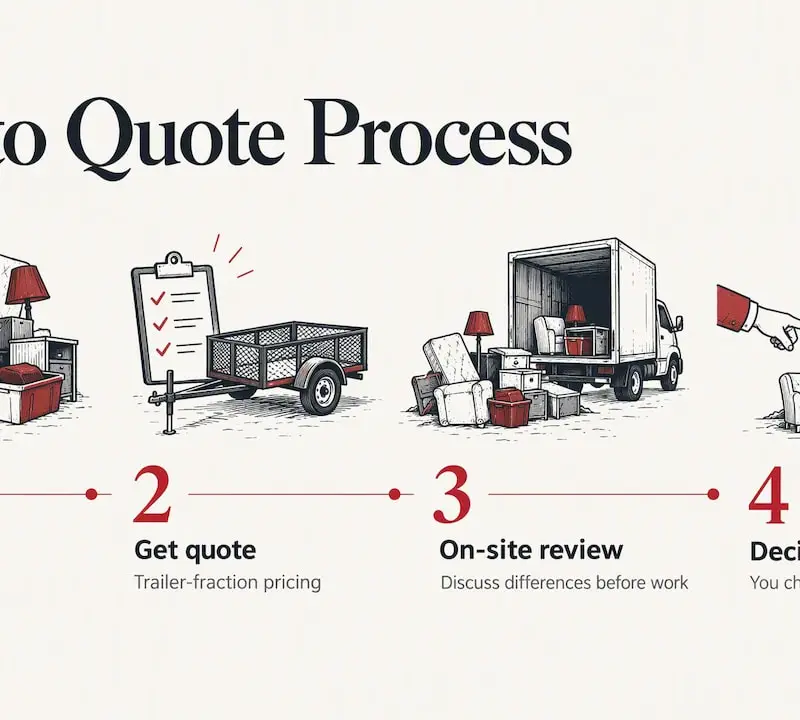
We’ll be straight about the limits. Photos don’t always show everything: piles tend to be bigger than they look, and what’s behind a closed door doesn’t appear in the picture. So when something looks different on site, we talk to you before we start, and you decide whether to go ahead. The number you approve is the number you pay.
Our advice on saving money is to group everything in one place (garage floor or driveway), tell us about stairs or tight access, and combine jobs. If your neighbor has a couple of items too, one trip for two households costs less than two separate minimums.
— Ben
How to get an exact quote before you book
- Gather your items. Even roughly. Piles in one spot are easiest to estimate.
- Take two or three photos. One wide shot of the whole pile, plus close-ups of big items like appliances or a hot tub.
- Tell us about access. Stairs, gates, distance from the driveway, whether items are indoors or out.
- Mention anything unusual. Freon appliances, electronics, paint or chemicals, wet or heavy debris.
- Get the price in writing. Confirm what’s included: labor, loading, haul-away and cleanup should all be in the number.
- Book a time. Most jobs fit into a short window, and we’ll confirm when we’re on the way.
When you’re comparing quotes from any company, ask the same four questions: Is the price by volume, item or weight? Does it include labor and cleanup? Are there fees for stairs, appliances or disposal? Is the quoted price the final price?
Ready for a number? Send us a photo for an instant estimate, or review our full pricing page first. We serve Parker and the surrounding area, including Castle Rock, Lone Tree, Littleton and Aurora.
Costs for homes versus businesses
Residential jobs are usually a few items to a garage or a whole-house cleanout. Property managers and landlords often need a unit turned over fast, with furniture, mattresses and leftover belongings gone in one visit. Because those jobs vary in size, we price them by trailer load, and repeat customers can ask us about scheduling.
For offices, retail spaces and renovation leftovers, see our commercial junk removal page. Commercial jobs don’t have a single published price because the volume, the access and the schedule differ so much. A photo or a quick walkthrough is the fastest way to a firm number.
For estate cleanouts the emotional side matters as much as the price. We treat belongings and the property with care, and we can separate items for donation or family review. Pricing follows the same volume logic, and the final number depends on how full the house is.
What’s usually included, and what to double-check
With our pricing, the crew does the lifting, the loading and the haul-away, and sweeps up the area where the items were. That’s the full-service difference from renting a dumpster or hiring a truck. Ask any company you’re comparing whether those pieces are in the quote or billed separately.
Two things we ask you to tell us about in advance are appliances with refrigerant, because of the $100 Freon handling fee, and anything hazardous such as paint, chemicals or fuel. Our what we take page lists the categories we accept so you aren’t surprised on pickup day.
FAQ
What is the minimum charge for junk removal?
Minimums exist so a crew can cover the cost of sending a truck out. Ours is $120 for a small load. Your own pile may need more, and we’ll quote it from a photo before we come.
How much does it cost to remove a single item?
It depends on the item. For us, a mattress is $150, a washer or dryer is $100 each, a refrigerator is $150 plus a $100 Freon handling fee, and a treadmill is $150. Couches are $150 for a 2–3 seat couch, $250 for a sleeper, and $350 for a large sectional.
What is the cheapest way to get rid of junk?
Donating or selling usable items is cheapest in cash. For everything else, hauling it yourself costs the least in dollars but the most in time and effort. If you want it gone in one visit, a volume-priced load keeps the cost predictable.
Is junk removal cheaper than renting a dumpster?
For a one-time cleanout it often is, once you count the dumpster rental, any weight overage and the hours of loading. For a long renovation with daily debris, a dumpster can make more sense. We can look at your project and tell you honestly which is better.
Can I get a firm price without anyone coming to my house?
Yes, for most jobs. Send photos and we’ll give you a quote based on the trailer-fraction table. If the pile turns out bigger than the photos suggested, we’ll explain before work begins and you choose whether to continue.
Sources
- How Much Does Junk Removal Cost? (Extra Space Storage)
- How to Price a Junk Removal Job: Truckload Rates and Margin
- How to Price a Junk Removal Job: Step-by-Step Guide (Jobber)